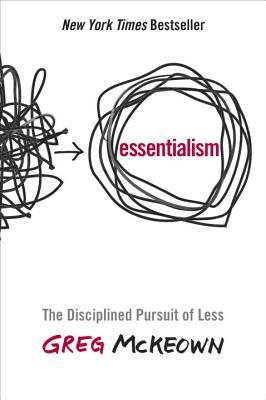
Essentialism isn't about getting more done in less time. It's about getting only the right things done. Have you ever found yourself stretched too thin? Do you simultaneously feel overworked and underutilized? Are you often busy but not productive? Do you feel like your time is constantly being hijacked by other people's agendas? If you answered yes to any of these, the way out is the Way of the Essentialist. Essentialism is more than a time-management strategy or a productivity technique. It is a systematic discipline for discerning what is absolutely essential, then eliminating everything that is not, so we can make the highest possible contribution toward the things that really matter. By forcing us to apply more selective criteria for what is Essential, the disciplined pursuit of less empowers us to reclaim control of our own choices about where to spend our precious time and energy -- instead of …
Essentialism isn't about getting more done in less time. It's about getting only the right things done. Have you ever found yourself stretched too thin? Do you simultaneously feel overworked and underutilized? Are you often busy but not productive? Do you feel like your time is constantly being hijacked by other people's agendas? If you answered yes to any of these, the way out is the Way of the Essentialist. Essentialism is more than a time-management strategy or a productivity technique. It is a systematic discipline for discerning what is absolutely essential, then eliminating everything that is not, so we can make the highest possible contribution toward the things that really matter. By forcing us to apply more selective criteria for what is Essential, the disciplined pursuit of less empowers us to reclaim control of our own choices about where to spend our precious time and energy -- instead of giving others the implicit permission to choose for us. Essentialism is not one more thing. It's a whole new way of doing everything. It's about doing less, but better, in every area of our lives. Essentialism is a movement whose time has come. - Jacket flap.
Greg McKeown's easy-to-read tome on 'Essentialism' is a field manual - a guide for the busy manager or multi-tasker who is poor at saying no to commitments, and who erroneously believes we can do it all. Reading this book is a valuable use of time for the new manager, or the seasoned leader who finds their success has bred too many different projects.
The overarching frame of reference is that there are two types of managerial and leadership behaviour (the book equivocates management and leadership together) - Essentialist and Non-Essentialist, and that effectiveness is the product only of the former.
The book is well structured and each chapter clearly articulates an aspect of being 'non-essential' - illustrating the consequences with (at times, kitsch) anecdotes. The solution is then provided, in the form of take-away behaviours that can be practised over time.
This book would have been improved with the addition …
Greg McKeown's easy-to-read tome on 'Essentialism' is a field manual - a guide for the busy manager or multi-tasker who is poor at saying no to commitments, and who erroneously believes we can do it all. Reading this book is a valuable use of time for the new manager, or the seasoned leader who finds their success has bred too many different projects.
The overarching frame of reference is that there are two types of managerial and leadership behaviour (the book equivocates management and leadership together) - Essentialist and Non-Essentialist, and that effectiveness is the product only of the former.
The book is well structured and each chapter clearly articulates an aspect of being 'non-essential' - illustrating the consequences with (at times, kitsch) anecdotes. The solution is then provided, in the form of take-away behaviours that can be practised over time.
This book would have been improved with the addition of the following artefacts:
- A wall guide or infographic contrasting the 'Essentialist' and 'Non-Essentialist' behaviours for easy reference and to refer back to
- A maturity model or similar allowing the fledgling leader to self-rate their behaviours
I also found this book lacking in solid empirical research; much of the narrative is fleshed with anecdotal rather than research or evidence-based information, which detracts overall from the credibility of the book.